Early this week, I was speaking with a colleague working for Mars Philippines, and we started talking about Korea. He asked,
“Why do you think Korea has grown so fast and become so influential in tech and culture, despite its small size and challenging history?”
It’s a question I’ve heard before — but this time, our conversation made me reflect more deeply. It gave me the chance to organize my thoughts and better articulate what Korea’s journey really means to me, both as a Korean and as someone leading teams across diverse Asian markets.
From Post-War Poverty to Global Soft Power
After the Korean War in the 1950s, South Korea was one of the poorest countries in the world. But within just a few decades, it became a global leader in technology, culture, and innovation — a transformation often called the “Miracle on the Han River.”
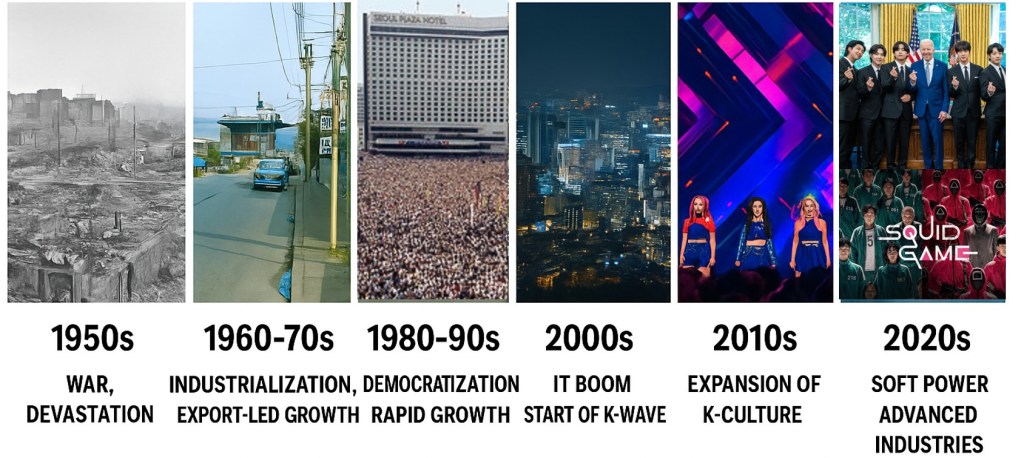
One important thing to understand is that the Korean War never officially ended. There’s only a ceasefire, not a peace treaty, which means South and North Korea are still technically at war. This tension has shaped our national mindset and system. As part of this reality, all Korean men must complete mandatory military service — I served 26 months in the Korean Navy, an experience that gave me deep perspective on discipline, national service, and collective responsibility.
A Geopolitical Pressure Cooker
Korea is uniquely positioned, surrounded by major powers — China, Japan, and Russia — with the U.S. playing a strong role in its security.
This geopolitical landscape has made Korea highly alert and competitive, especially in areas like education and employment. Over time, this gave rise to a national culture of hard work, perseverance, and striving to always stay one step ahead.
Among the younger generation, this hardworking spirit is taking a different form. Rather than dedicating themselves to a single company, many are now focusing more on self-development — pouring their energy into building skills and personal competitiveness.
It’s less about long-term loyalty, and more about giving their best in each moment and making the most of every opportunity they face. This shift reflects not a loss of commitment, but a more agile and adaptive approach to success in today’s fast-changing world.
Turning Constraints Into Creativity
What inspires me most is how Korea turned its limitations into a launchpad for creativity. The government didn’t just invest in infrastructure and industry — it also supported education, startups, and cultural industries.
From that grew the global wave we now call K-Culture:
K-pop, Korean dramas, films, fashion, and food that people around the world now know and love.
From BTS and BLACKPINK to Parasite and Squid Game, Korean culture has gone from something niche to something globally influential.
And behind that success are decades of effort, innovation, and a deep belief in the power of storytelling and identity.

ChiefTree’s Spark
Korea’s story offers an important reminder — for countries, companies, and even brands. Constraints don’t have to be obstacles. Often, they are the very conditions that spark innovation and lead to true uniqueness. K-Culture may have taken time to grow, but it became something deeply distinctive — and because of that distinctiveness, it resonates across the world.
If you focus on your own core — your nation’s or brand’s DNA — and embrace both your limitations and strengths, you may uncover the foundation for real influence.
What feels like a disadvantage today may be the reason people connect with you tomorrow.


 ChiefTree's Blog
Leave a comment